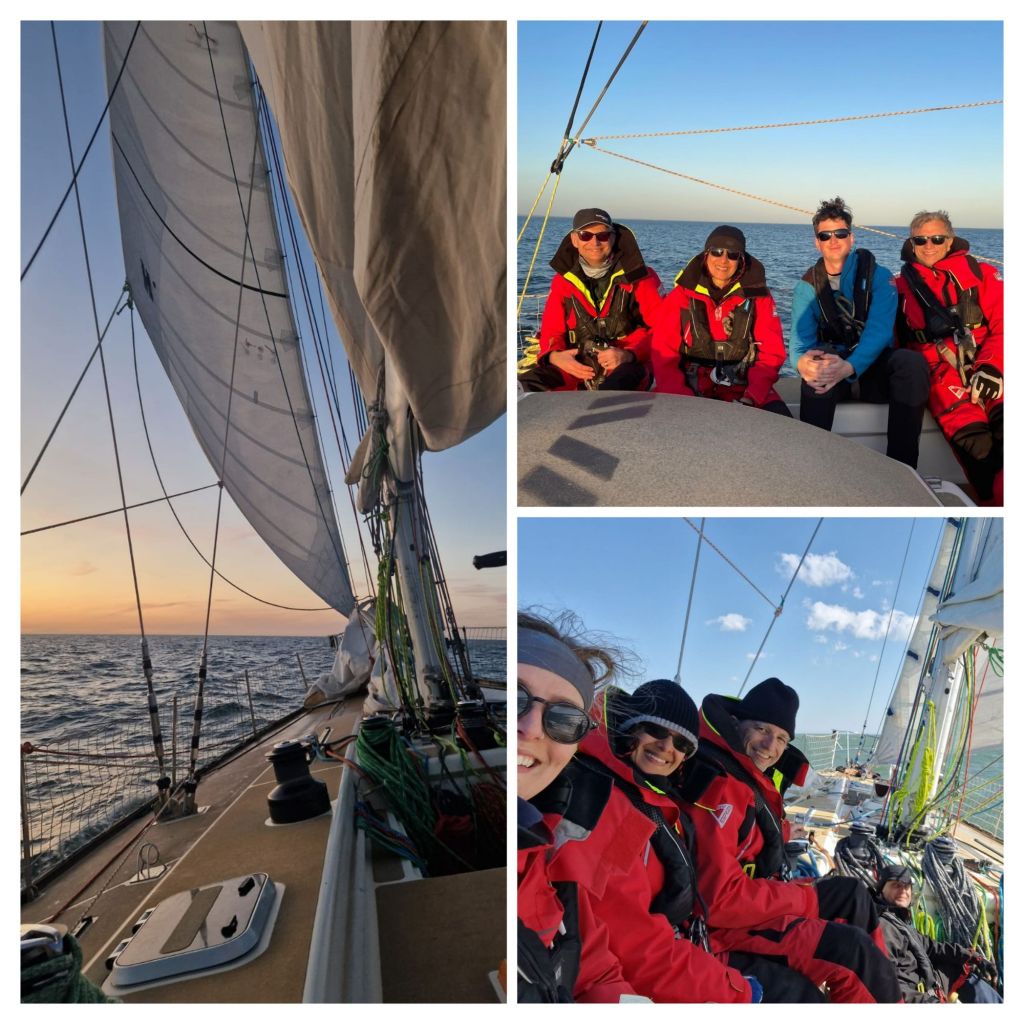
Before Level 2 kicked off, the Clipper Race Skippers were announced, and this would be our first time sailing with them — a proper glimpse of the professionals who would lead us through the race itself.
For this week, we had two brilliant skippers:
Lou Bouman – A powerhouse of experience: British, Irish, and Welsh female sailing champion, youngest skipper of the Round Britain and Ireland Race, now Clipper Race Skipper. I didn’t know it yet, but I’d be seeing a lot more of Lou. By the end of the week, I’d even be putting in a request to have her as my skipper. Let’s see what happens.
Philip Quinn – Irish, returning skipper from the previous Clipper edition with over 40 years of sailing experience. Calm, clear, and focused — ready to help everyone push their limits.
The crew this time:
Marcie (UK)
Andrew (US)
Chris (Sweden)
Lorenzo (Italy)
Jane (UK)
Nina (UK)
Matt (US)
It was my second time on a sailing yacht, back on the Clipper 68s for one last round before progressing to the race yachts. And this week, we’d get a proper introduction to watch systems — rotating through 4 hours on / 4 hours off overnight, with 6-hour watches during the day. A brutal 3 a.m. wake-up included.
Sea Survival: A Day You Never Forget
We kicked off with Sea Survival Training — first in the classroom, learning the hard realities of what can go wrong: stories of sunken vessels, survival against the odds, and everything you hope you never experience. We covered emergency protocols, lifejackets, flares, abandon-ship drills — then it was into the pool.
In full foul-weather gear, we learned how to work together in the water: flipping liferafts, helping each other onboard, climbing in solo, even how to huddle for warmth. Tough, practical, and surprisingly fun in a ‘hope we never need this’ kind of way.
Into the Watch Routine
From there, it was onto the boat. The usual introductions, safety drills, sleeping dockside for one night, then straight into full-time sailing — staying out every night and living in the watch system.
Our four-person watch with Marcie, Chris, Matt, and me. Chris, steady and skilled. Matt, endlessly positive, the type of person who makes you feel better just by being around. And Marcie — without a doubt the best person I’d sailed with so far: experienced, patient, and genuinely kind. She made Level 2 infinitely better. Easily my favourite sailing buddy.

Finding My Feet (and the Helm)
We faced some pretty choppy seas during the week. One particularly rough night stands out – After a hard shift battling through the waves, we were wrecked. Seasick, exhausted, and desperate to collapse in our bunks. Four hours later, dragging ourselves back on deck was a mission. I ended up lying on the sail bags by my bunk just to get my foulies on.
Then came my first time helming. No idea what I was doing. I tried, turned too far, dead-tacked the boat, and we had to put the engine on. Great… first time at the wheel and I stalled the yacht.
It dented my confidence, but I knew this was all part of learning. I stepped back from the helm for the next watch, knowing I’d be back. Marcie encouraged me to get back up there, reminding me sometimes it’s better to just push through.
Coming back into Portsmouth, I was back on the helm — with Lou guiding me through. Thanks to Marcie for making sure I got back up there, and to Lou for calmly coaching me. I steered us back through the busy shipping lanes, and for the first time, it felt good.
Not perfect. Not polished. But a solid reminder: you can come back stronger after mistakes.
Anchor Watches and Problem Solving at Sea
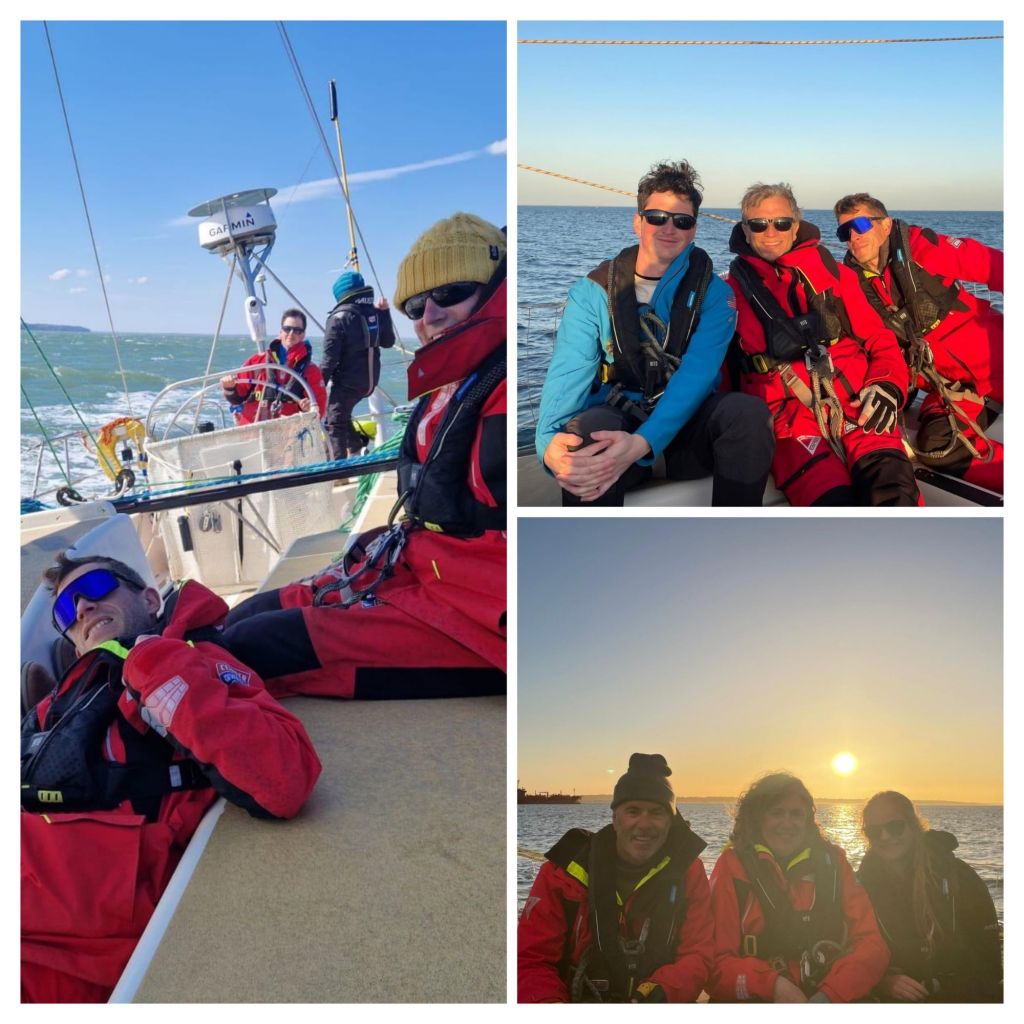
One night we dropped anchor off the coast of the Isle of Wight — a different rhythm after the usual safety drills and sail evolutions, and a welcome break from the constant watch system. Instead of the usual four hours on, four hours off, we rotated through anchor watches: two hours on, two people at a time, with staggered shifts so you’d spend an hour with one crewmate, then swap and spend an hour with another. Each hour we’d log three compass bearings to make sure we weren’t drifting, and check the anchor chain wasn’t dragging.
It turned into a beautiful, clear night — stars overhead, calm sea — the kind of quiet moment you don’t get often offshore. A chance to chat, gaze up, and actually enjoy the surroundings. A good reminder of why we were out there.
Morning came, and the anchor had other ideas. When it was time to leave, the chain wouldn’t budge — completely stuck under the keel of the boat. That’s when you see how good skippers earn their stripes. Phil quickly came up with a couple of options: first, someone could suit up in the swimmer’s kit, get lowered down, and attach a halyard further down the chain. I volunteered. But before it got to that, Plan B was on — re-leading the chain to the stern and hoisting it from there. It worked, after some effort.
It cost us a couple of hours but was genuinely interesting to see the teamwork and problem-solving in action. Anchoring isn’t something we’ll do much during the race, but it’s good to have in the back pocket for whatever challenges come up.

Wrap-Up: Lessons, Progress, and Future Hopes
Near the end of the week, the Clipper media team pulled me aside for a quick chat. They asked about why I was doing the race, my background, and how I was finding training so far. Next thing I knew, they were asking if I’d be happy to feature in a press release — possibly a local newspaper article or even a radio interview. Let’s see what happens.
It was a great week — working through evolutions, safety drills, and sailing challenges. It definitely felt different from that first week. Less “what’s a rope called again,” more pushing myself, more responsibility. Still loads to learn, but it was starting to click. A tougher routine, harder conditions, but another great crew — and it made a huge difference. My last time on the 68s, and I finished it having made a great friend in Marcie, improved massively at the helm, and found a skipper I really hoped to sail around the world with.
Level 2 had been a tougher week — harder watches, rougher seas, more pressure — but also bigger wins. I left knowing I’d improved, hoping to sail with Lou and Marcie again, and reminded that the real takeaway was simple:
whatever happens… just keep sailing.
 From Heartbreak to Headwinds
Leave a comment