Before the training even started — when I first began telling people about this next adventure — the question always came up: “Why?”
Why sign up to sail around the world with strangers? Why spend months at sea? Why put yourself through all of that?
It’s a question I heard a lot, and truthfully, it’s not always easy to answer. I’ve thought about how to answer the question a lot and there isn’t one neat, polished reason. But the simplest thought is this:
I love an adventure.
Some people backpack. Some book cruises. I signed up to race across oceans with a crew of strangers and zero sailing experience. What better way to travel around the world than by wind and grit, on the open ocean in the Clipper Race?
It’s not about luxury. It’s not about ticking boxes. It’s about the challenge, the unknown, the rawness of it all. The sea doesn’t care who you are — and there’s something about that which feels incredibly honest.
Day One: Introductions & Ignorance
So here we are. The start of Clipper Race training.
No sailing experience. No real idea what’s ahead. And strangely… no nerves. Just a calm sense of “right, let’s do this.” Maybe it’s denial. Maybe it’s growth. Either way, I showed up with an open mind, a sturdy waterproof bag, and a mild fear of knots.
Week one kicks off with 12 strangers from all over the world — different accents, ages, and reasons for being here. Some have sailed since childhood. Some (like me) signed up after seeing a Facebook ad and mistook it for a sensible life decision.
It’s a mix of theory, kit checks, awkwardly getting into lifejackets, and trying to remember whether “port” is the left side or a strong drink (spoiler: it’s both). The instructors are patient and low-key, which helps. No one’s barking orders. Yet.
There’s something grounding about being completely new at something again. No expectations to live up to. Just the quiet satisfaction of showing up, paying attention, and not falling off the pontoon.
So far, so good.
The Boat
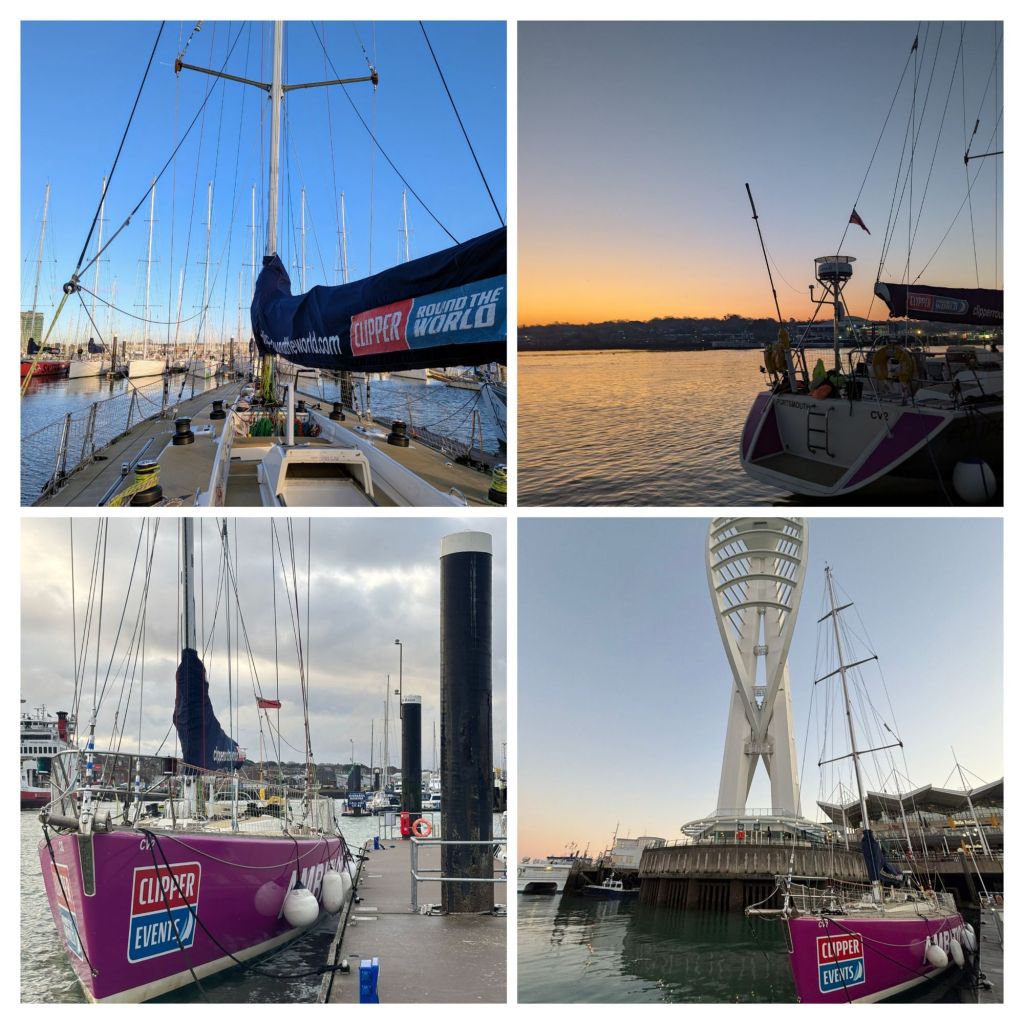
Training began aboard CV2, one of the Clipper 68s — former race boats now used for Level 1 and 2 training. No frills, no creature comforts. Just sails, steel, and the promise that we’d know a lot more in seven days than we did when we stepped aboard.
Our instructors were:
David – Skipper (UK), experienced, direct, extremely hot on safety — and not shy about raising his voice when needed.
Abbie – First Mate (UK), calm and clear, excellent at explaining things when everyone looked blank.
Mike – Second Mate (UK), patient and solid, always ready with a quiet tip or correction.
The Crew
Our fellow trainees:
Hannelle (UK – Leg 2)
Gus (Spain – full circumnavigation)
Robin (UK – Leg 3)
Piotr (Poland – Leg 3)
Sven (UK – Leg 1)
Ian (UK – Sadly had to withdraw due an Injury he picked up on his Level 2 training)
Julia (Germany – Leg 6)
Margaux (France – Leg 1)
Terry (Canada – Legs 4, 5, 6 & 8)
Chris (South Africa – Leg 4)
Caroline – UK who sadly had to withdraw partway through the week due to seasickness, despite giving it everything she had. Brave, honest, and a reminder that the sea doesn’t always give you a choice.
On that first day, sitting in the cockpit, we introduced ourselves and shared our reasons for joining — and, more tellingly, our concerns. Sea sickness. No sleep. Cold nights. Living with strangers. All valid. When it came to me, I shrugged: “That’s all part of the gig. It’s going to happen, and I’ll deal with it.”
David, with a knowing grin, replied, “Ignorance is bliss.” 😬
Learning the Ropes (Literally)
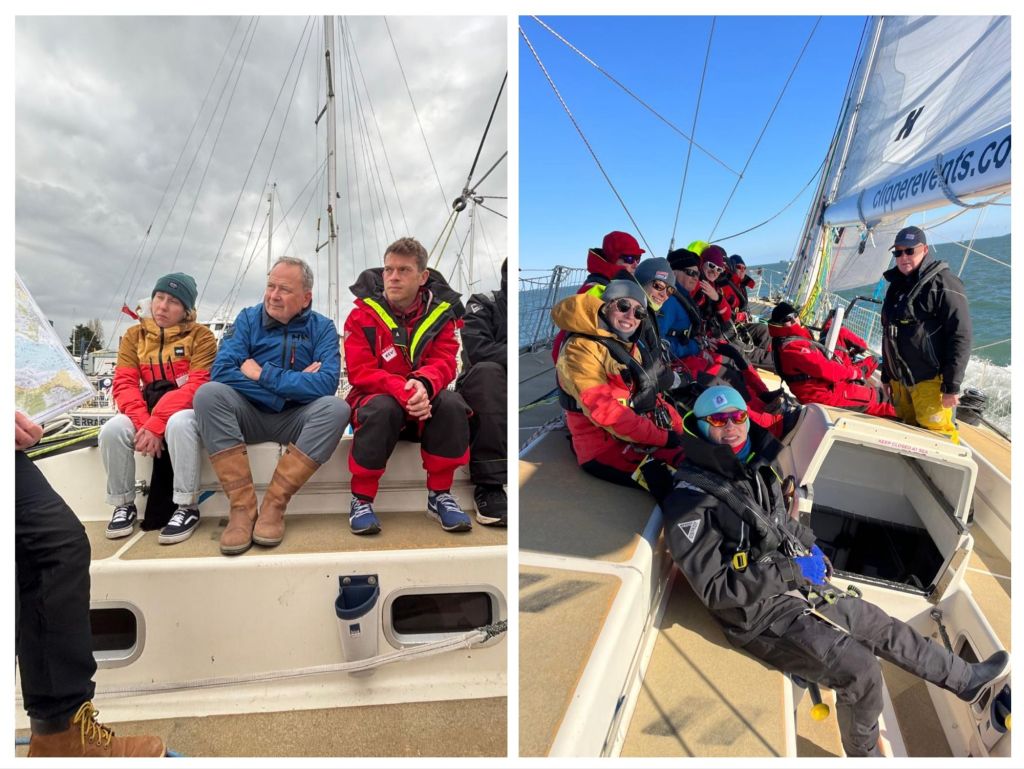
The first day we began alongside the pontoon, running through safety drills and emergency kit. Then over the next few days out we went — into the Solent, where everything became very real, very fast. We learned to hoist sails, tack, reef, flake sails, grind winches, man over board drills and communicate without shouting (or sometimes while shouting). The learning curve was steep, and the deck was always moving.
We were split into pairs for rotating galley duty — known as “mother watch.” Cooking for the full crew while the boat rocks around is humbling, and dangerous for loose pasta.
We also covered engine checks and the basics of navigation — Every hour, someone was responsible for updating the ship’s log — recording wind speed, compass bearing, position, cloud cover, sea state, and a bunch of other things I didn’t fully understand at the time. I wrote a lot of it down with confidence, and absolutely no idea what half of it meant.
Terms like barometric pressure and cloud type felt like GCSE geography I hadn’t revised for. Still, we got the hang of it. Slowly, the numbers and terms started to mean something
At one point we ran a Man Overboard drill — where a lifeless dummy named BOB is thrown over the side, and the crew has to respond like it’s the real thing. I ended up as the designated swimmer, clipped on and lowered down the side of the boat to “rescue” him. It was cold, slightly awkward, and a bit surreal — dangling off the side of a yacht, saving a heavy, concrete filled dummy called BOB. But also strangely satisfying. BOB was safely recovered, and I managed to stay dry. Win-win.

Sea Legs & “Keep Sailing”
Some crew got seasick — and yes, I felt it too. One day in particular hit hard while Gus and I were on mother watch. Trying to cook for 13 people while the boat lurched around was… character building. We both had to stop at points just to catch our breath — me more so than Gus.
Credit to him: he powered through, kept stirring, and made sure the meal made it to the bowls. I’m genuinely grateful for that. At that point, even the smell of the galley was a challenge.
That evening, during the debrief, when asked how the day went, I just said:
“It happened. Keep sailing.”
It became my quiet motto for the week. Not profound. Just practical.
A Week That Changed Everything
By the end of the week, I still couldn’t tie every knot from memory. I still had to glance at my hands to remember which side was port. But I knew one thing with certainty: I was in the right place.
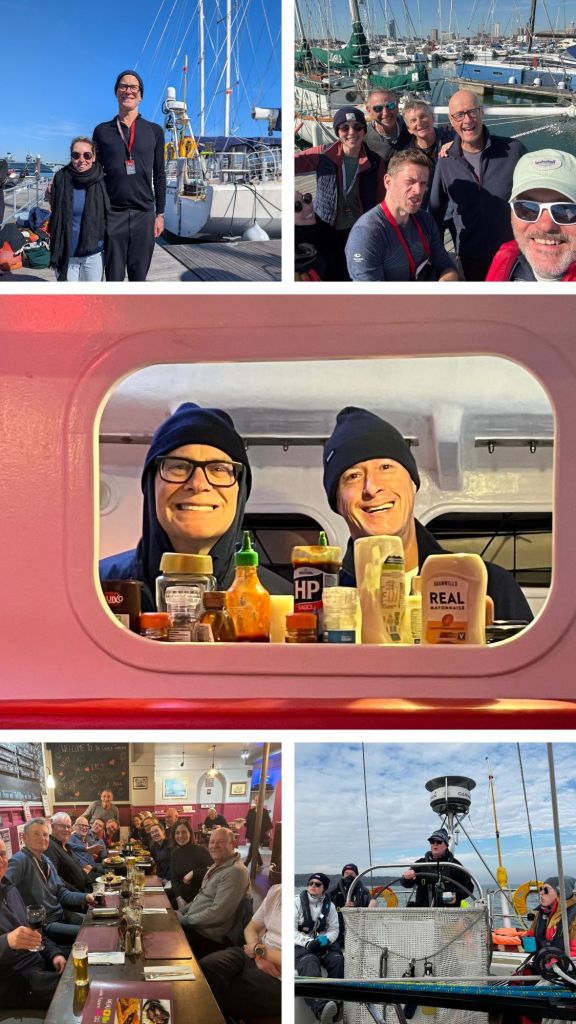
These were the first people I ever sailed with. We learned together, laughed through our mistakes, and made a floating, awkward, brilliant home out of a training yacht called CV2.
I left Level 1 not with doubt, but with more certainty than I’d had in a long time.
This was the beginning of something big — and I was all in…. Keep Sailing!
Link to video of our Level 1 training made by favourite Polish friend Piotr.
https://youtu.be/v3PVYtDqx00?si=zsHO63G-MxCAwkBr

 From Heartbreak to Headwinds
Leave a reply to Ian Cancel reply